-


Me voici toujours avec Fanny Bouton, dans le 68e épisode de Quantum, le podcast francophone de l’actualité quantique. Au menu de cet épisode, l’inauguration de CESQ à Strasbourg, l’APS Global Summit d’Anaheim, le NVidia Quantum Day à San Francisco, des actualités concernant Alice&Bob, Pasqal, Quobly, Chipiron, Welinq, ColibriTD puis à l’international sur IBM, IQM, QuamCore, la Chine, D-Wave, IonQ, PsiQuantum, SEEQC, Google, l’Union Européenne puis quelques poissons d’avril quantiques.
Événements
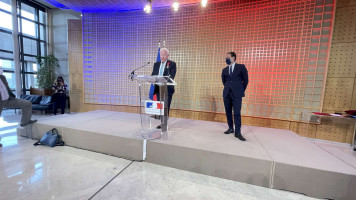
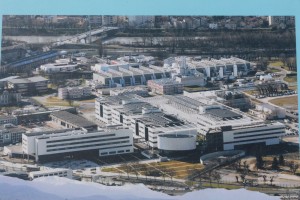
Conférence au CESQ à Strasbourg.
[...]
-

Understanding quantum computing’s pace of progress is not an easy task. Recent months have complicated it with contradictory messages. CEOs like Jensen Huang (Nvidia) and Mark Zuckerberg (Meta) estimated that useful quantum computers were decades away, while others like Satya Nadella (Microsoft) and Sundar Pichai (Google) cast it as being just years from now. Some companies even stated that quantum computers would soon run LLMs more efficiently, with a lower energy footprint than classical HPCs running Nvidia GPUs.
[...]
-
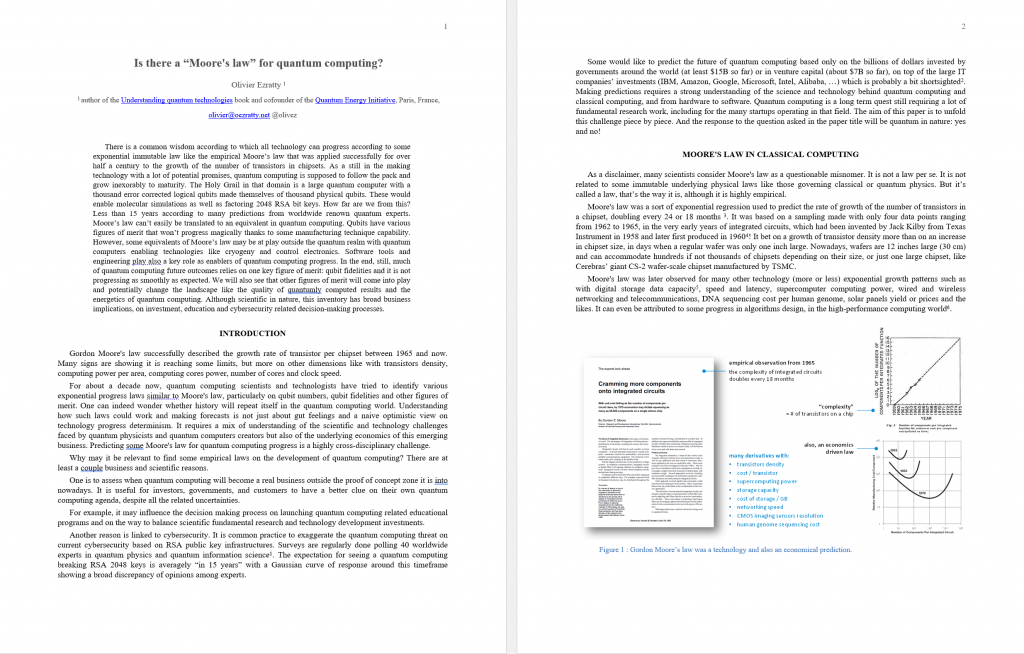
I’m continuing a series of broad review papers on quantum computing after Disentangling quantum emulation and quantum simulation that I published in January 2023.
In this new essay, I try to answer a very commonplace question or wisdom: will Moore’s law be also applicable for quantum computing. The answer is: yes and no! And in quantum computing, there’s an ongoing challenge to assemble both quality qubits and a large number of these qubits. And there’s so much entanglement between various figures of merits and quantum+classical technologies plus such a zoo of different types of qubits that a simplistic exponential regression like Moore’s law is hard to make. On top of that, Moore’s law was rapidly applicable for chipsets that were of practical use and contributed to the birth and rapid expansion of the personal computer market, then to the Internet and the smartphone and all things connected from supercomputers, cloud data-centers down to the tiniest connected objects. Here, with quantum computers, we have not passed the threshold of real utility and the economical drive that did fuel Moore’s law is not yet at play.
[...]