


Understanding Quantum Technologies 2026
Post de Olivier Ezratty du 28 septembre 2026 - Tags : Actualités,Quantique | No Comments
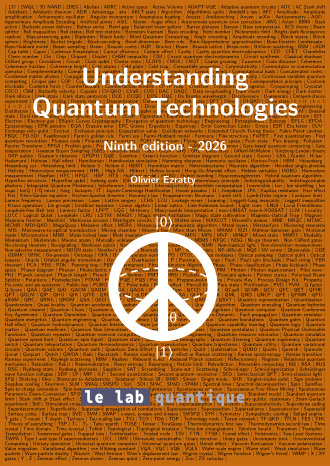
Here is Understanding Quantum technologies 2026, the 9th edition of this book I initially created in 2018.
This is the only real full stack book on quantum science and technologies. And it’s always free.
As usual, this post describes the book organization, how to download it, including the short format version of 42 pages, its new content and its uniqueness.
The stuff to know:
Book organization
The structure of the book is the same as with the last editions:
Part 1 “Prologue” (450 pages) starts with the history of quantum physics and quantum physics 101. It then describes how gate-based quantum computing operates, and then quantum computing engineering with quantum computer systems architecture, quantum error handling, quantum memory, quantum energetics, and how to deal with uncertainty and economics.
Part 2 “Computing hardware” (534 pages) contains a description of all qubit types with their science, engineering and vendors offerings and roadmap, then quantum enabling technologies, and unconventional computing. It is probably the most detailed place describing what industry vendors are doing. Its size grew due to the additional vendors to cover and to more scientific insights.
Part 3 “Computing software” (420 pages) covers quantum algorithms, software tools, use cases and case studies across about 20 different markets (chemical engineering, life sciences, transportation, financial services, etc.). Key algorithms like the QPE are better described. Case studies and use cases are highlighted with a color badge (NISQ, FTQC, analog).
Part 4 “Communications and sensing” (210 pages) contains the parts related to quantum communications, quantum cryptography, post-quantum cryptography and quantum sensing.
Part 5 “Ecosystem” (254 pages) describes quantum ecosystems throughout the world from the entrepreneurial to the country scene, corporate adoption, quantum technologies and society, and quantum fake sciences, plus a glossary, and index. This part grew significantly due to the doubling in size of the glossary.
Getting the book
This book is directly downloadable as a PDF file with no required personal data, with an optional lighter version for a readers like Amazon Kindle split in 5 files. A paperback printed version will also be available in November 2026 on Amazon.
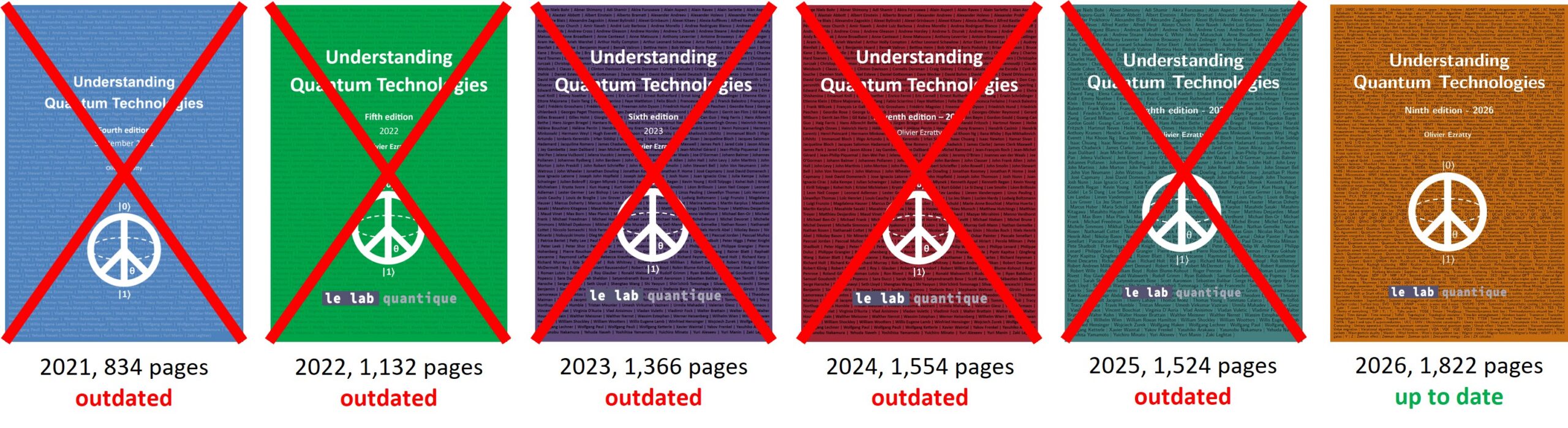
I continue to use a color code to help you remember which edition we are talking about. The previous editions were in dark green (2025), red (2024), purple (2023), green (2022) and blue (2021) and are all outdated.
Here are the various PDF versions available for download. You’ll be better off downloading the relevant files just before your start reading it since I continuously update the document until January 2027.
This book current version is 9.0, generated on October 17th, the updates log being at the end of the single book file or at the end of part 5.
Downloads are available with either a singe PDF file containing the full book with images in full resolution (1,822 pages, 585 Mb) or split in five smaller parts with compressed images. The page numbers of A4 and Letter format files are consistent from part to part, but not from single part 2-to-5 and the single file versions. For example, page N in Letter Part 3 matches page N in the A4 Part 3. But the page numbers are not the same between the full book PDF version and the five parts versions.
I also updated the short version of the book which is only 42 pages long (images in best resolution, 8 Mb). It is an illustrated compilation of the “key takeaways” from the end of each book’s parts.
New features
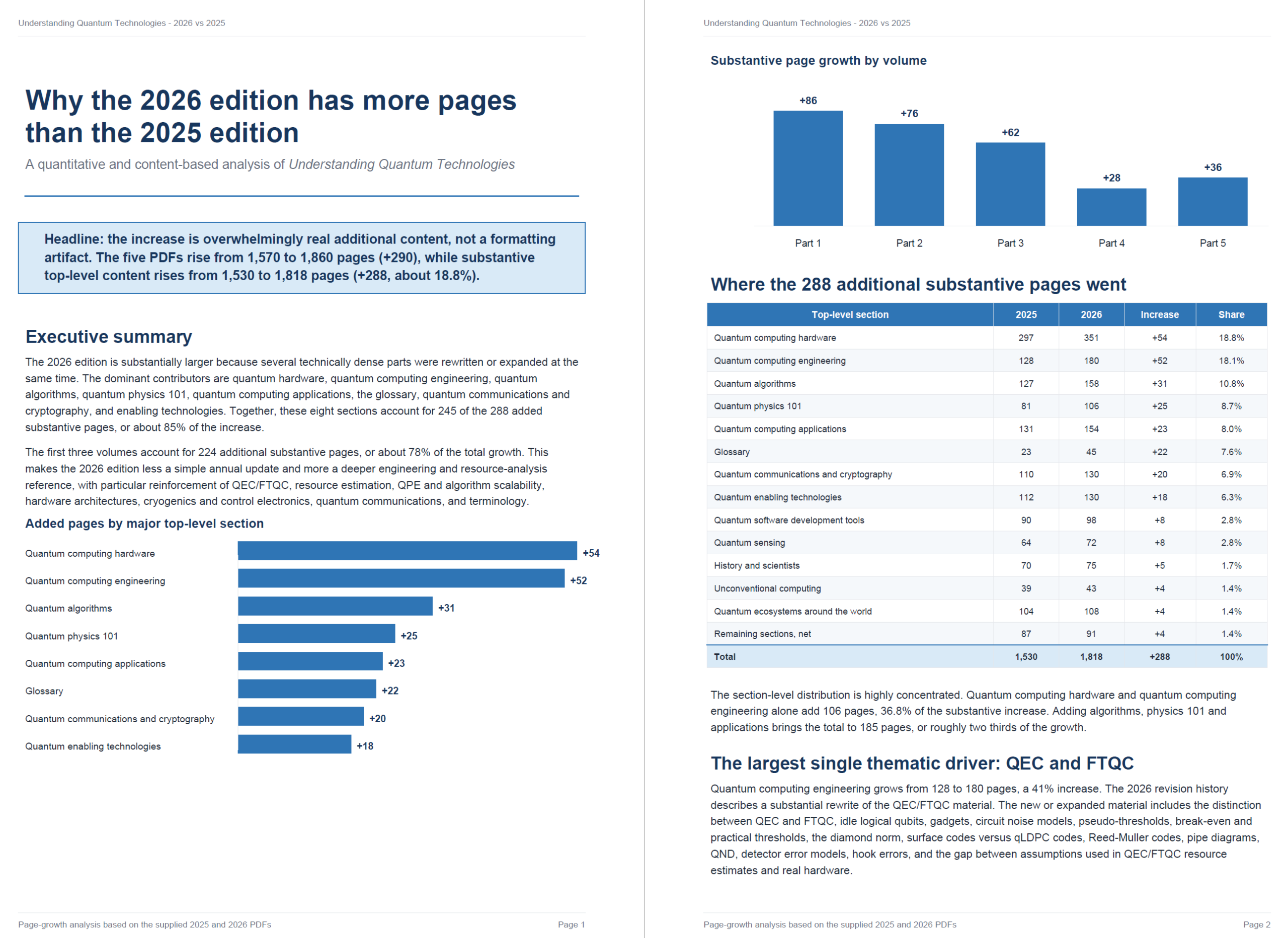
Like all previous editions, this 9th edition is an update. And it’s back in growing the number of page, gaining about 300 pages in total, including 92 pages in the bibliographies. Its key changes and new features are detailed in the revision log at the end of the book:
There is also a nice foreword by Philippe Grangier, from IOGS and SFO.
To be efficient, I asked ChatGPT 5.6 to make a comparison between the 2025 and 2026 editions and he does this pretty well pretty well.
Facts and figures
Here are some statistics on the book content:
Audience
This ebook target audience is broad but rather technical. Some parts are accessible to non-scientific readers, particularly the geopolitics and societal parts at its end. Other parts require some scientific background at the licence or master level. Reading the many referenced scientific papers requires at least a master level, if not a PhD level in the related domains.
The first target audience are computer science and information technology specialists, and software developers who want to understand the whereabouts of quantum computing hardware, software and use cases. It is also made for students and professionals who are attracted by quantum technologies and would like to develop some skills in this emerging domain. Many quantum startups ask their new hires to learn their field with this book!
It is also interesting for most quantum scientists, engineers and entrepreneurs since most of them are specialized in a narrow field while this book provides an up-to-date 360° view on all quantum technologies. Covering all of this is nearly a full-time-job and most quantum physics or technology specialist don’t have the time to follow the related continuous scientific news cycle.
I also know many readers who enjoy the charts, and particularly the vendor market maps and metrics!
I recommend to use tools like Google Notebook LM to interrogate the book as I explained in this post in 2024 for the 7th edition of the book.
Business model
It has not changed since the last edition. I favor distribution over revenue. I am an advocate of open science. I benefited from it when looking for scientific data when learning quantum science and technologies. Otherwise, I sell my time in a traditional and non-scaleable way with speaking, teaching, training and various consulting missions. I even do some research in quantum foundations, and as part of my work as a cofounder of the Quantum Energy initiative. Another way to describe my business model is I give away the long version and sell the short one. Since with businesses, time is money and students have time but no money, all things go round. This is particularly true with quantum technologies which “nobody understands“.
But the real business model is “emotional”. Having a worldwide impact on students and other people who want to learn anything about quantum science, technology and its ecosystem, is the best reward for a content producer! Thus the importance of getting some feedback, particularly to improve the book on an ongoing basis.
Reviewers
This book and its previous editions benefited from the help of several scientists and entrepreneurs who proofread the document, mostly on specific parts. As the book size grows, it is a huge challenge to get some time from scientists to review such a book. They are short on time!
Specific help for crafting this 9th edition came from Michel Kurek who carefully reviewed several times the whole book as with many previous editions and even developed some Python script and LLM prompts to detect various problems and also from Jean-Philippe Nominé, Daniel Vert and Vincent Pinte-Deregnaucourt. I got a lot of help from ChatGPT 5.6, Claude Opus 4.X and 5.0 and Gemini Pro which I describe in details in the “making of” section at the end of the book. This book is also supported by le Lab Quantique (not financially, but for its visibility).
I appreciate any feedback, corrections, updates and suggestions, particularly if you are one of the 970+ vendors mentioned, and even anecdotes or stories on how you use this book. I update the book content whenever required until the end of the year.
Good reading,
Olivier Ezratty
September 2026




Lien du blog Opinions Libres : https://www.oezratty.net/wordpress
Lien de l'article : https://www.oezratty.net/wordpress/2026/understanding-quantum-technologies-2026/
Cliquez ici pour imprimer
(cc) Olivier Ezratty - http://www.oezratty.net